• Sigachi
  • Publications, Uncategorized
  • No Comments

Formulation and in-vitro Evaluation of
Extended Release Metformin
Hydrochloride Directly Compressible
Tablets by Using ULTRAMODTM
Polymer Premix

Viraj Kulthe a++*, Rauf Pathan  and Amit Raj Sinha b
a SIGACHI® Industries Limited, Dahej SEZ, Bharuch, Gujarat, India.
b SIGACHI® Industries Limited, 4th Floor, Kalayan’s Tulsiram Chambers, Madinaguda,
Hyderabad, Telangana, India.
Authors’ contributions
This work was carried out in collaboration among all authors. Author VK conceptualized and
supervised the study. Author RP performed experimental work wrote the manuscript. Author ARS
analyzed the data and reviewed the manuscript. All authors read and approved the final manuscript.
Article Information
DOI: https://doi.org/10.9734/jpri/2025/v37i117772
Open Peer Review History:
This journal follows the Advanced Open Peer Review policy. Identity of the Reviewers, Editor(s) and additional Reviewers, peer
review comments, different versions of the manuscript, comments of the editors, etc are available here:
https://pr.sdiarticle5.com/review-history/146485


_____________________________________________________________________________________________________
++ Senior Manager;
*Corresponding author: E-mail: viraj.kulthe@sigachi.com;
Cite as: Viraj Kulthe, Rauf Pathan, and Amit Raj Sinha. 2025. “Formulation and in-Vitro Evaluation of Extended Release
Metformin Hydrochloride Directly Compressible Tablets by Using ULTRAMODTM Polymer Premix”. Journal of Pharmaceutical
Research International 37 (11):156–165. https://doi.org/10.9734/jpri/2025/v37i117772.

Journal of Pharmaceutical Research International
Volume 37, Issue 11, Page 156-165, 2025; Article no.JPRI.146485
ISSN: 2456-9119, NLM ID: 101716968
(Past name: British Journal of Pharmaceutical Research, Past ISSN: 2231-2919,
NLM ID: 101631759)

Formulation and in-vitro Evaluation of
Extended Release Metformin
Hydrochloride Directly Compressible
Tablets by Using ULTRAMODTM
Polymer Premix
Viraj Kulthe a++*, Rauf Pathan a and Amit Raj Sinha b
a SIGACHI® Industries Limited, Dahej SEZ, Bharuch, Gujarat, India.
b SIGACHI® Industries Limited, 4th Floor, Kalayan’s Tulsiram Chambers, Madinaguda,
Hyderabad, Telangana, India.
Authors’ contributions
This work was carried out in collaboration among all authors. Author VK conceptualized and
supervised the study. Author RP performed experimental work wrote the manuscript. Author ARS
analyzed the data and reviewed the manuscript. All authors read and approved the final manuscript.
Article Information
DOI: https://doi.org/10.9734/jpri/2025/v37i117772
Open Peer Review History:
This journal follows the Advanced Open Peer Review policy. Identity of the Reviewers, Editor(s) and additional Reviewers, peer
review comments, different versions of the manuscript, comments of the editors, etc are available here:
https://pr.sdiarticle5.com/review-history/146485
Received: 08/09/2025
Published: 11/11/2025

ABSTRACT
Aims: Different types of drug release modifying polymers, their grades and quantities have to be
optimised in the formulation considering solubility characteristics and biological half-life of the

drugs. Further, formulations containing such discrete ingredients processed by conventional, multi-
step manufacturing techniques can be a resource-intensive and challenging task for the

formulators. This necessitated development of ready-to-use, co-processed polymer premixes.
Original

Methodology: Present study proposed to develop an optimised composition of a polymer premix,
ULTRAMODTM and evaluate its performance in modifying release of highly water-soluble model
drug (BCS Class III) having short biological half-life, metformin hydrochloride. Blend micromeritics
and tablet physical properties and performance (in-vitro drug release) were evaluated by
pharmacopeial methods.
Results: Such formulations showed excellent flow and compressibility properties, tablet physical
properties and drug release compared to the pharmacopeial specifications. These quality attributes
and release modifying performance of the polymer premix stored at accelerated stability conditions
for 6 months also was unchanged.
Significance: The present research contributes to scientific formulation management by
demonstrating how co-processed polymer premixes simplify extended-release tablet design,
reduce formulation optimization trials, and enhance manufacturability. ULTRAMODTM
offers a scientifically robust and industrially scalable approach to developing matrix
tablets for highly water-soluble drugs, minimizing batch variability and reducing production cost and
time.
Conclusions: Ready-to-use, co-processed polymer premix proved to be an advantageous
substitute to conventional polymers. This reduced formula optimisation challenges, manufacturing
complexity and promises quick commercialisation.

1. INTRODUCTION
The development of oral drug delivery systems that optimize therapeutic efficacy while enhancing patient compliance has been a significant focus of pharmaceutical research. Among these, modified release formulations have substantial interest, particularly in the management of chronic conditions such as diabetes mellitus, where maintaining consistent drug plasma levels is crucial for effective treatment (Brahmankar and Jaiswal, 2009). Oral drug delivery is the most widely utilized route of administration among all other routes that have been explored for systemic delivery of drugs. The oral route offers advantages such as ease of administration, patient acceptance, and cost-
effective manufacturing process (Chein, 1992). The objective of designing modified drug release delivery systems is to reduce the frequency of dosing or to increase the drug’s effectiveness by localization at the site of the action, reducing the dose required, or providing uniform drug delivery (Rajarao and Rohini, 2020). The success of modified release formulations depends largely on
the choice of polymer used in the tablet matrix. Polymers control the rate at which the drug is released from the formulation, and selecting the appropriate polymer is critical to achieving the desired release profile (Sousa et al., 2023).
Traditional polymers like hydroxypropyl methylcellulose, ethyl cellulose, and
carboxymethyl cellulose sodium have been widely used because of their predictable and reliable drug release modifying characteristics (Pockle et al., 2023). Metformin hydrochloride (Metformin HCl), which is basically used in the treatment of type 2 diabetes, is often formulated in such extended release forms to overcome the limitations such as gastrointestinal side effects, frequent dosing, shorter duration of action associated with its immediate-release counter parts (Lalla, 1991). Metformin HCl popularly formulated into a modified drug release system because it is a highly water-soluble active pharmaceutical ingredient with short half life. Such formulations ensure more stable blood sugar levels, and reduced dosing frequency also, which improves
patient adherence (Modi et al., 2011). While previous studies have modified the release of metformin HCl using wet granulation, this method presents significant formulation challenges, including drug-polymer incompatibility during aqueous processing, variability in granule particle size distribution, and prolonged processing time (Roy et al., 2013). Wet granulation often necessitates additional steps such as binder optimization, drying control, and moisture- sensitive stability testing, which complicate scale- up. In contrast, direct compression method using ready-to-use polymer premix eliminates these hurdles by avoiding water exposure, ensuring uniform drug-polymer blending, and streamlining manufacturing are critical advantages for robust
extended-release metformin HCl tablets (Takasaki et al., 2015). This research explores
the formulation and in vitro evaluation of extended release metformin hydrochloride tablets formulated with ready-to-use co- processed polymer premix. ULTRAMODTM is a proprietary polymer blend designed to achieve extended-release formulations. It comprises HPMC and carboxymethyl cellulose sodium, which work synergistically to control the drug release profile.
It offers improved flow compressibility and hydration properties, making it suitable for direct compression tablet manufacturing. Its ability to form a consistent gel matrix that modulates drug release effectively. Development of ready-to-use co-processed excipients like ULTRAMODTM marks a significant advancement in the field of pharmaceutical formulation development and
their commercialization. This simplifies tablet manufacturing through its excellent micromeritics, eliminating the need for wet granulation (Takasaki et al., 2015). Use of such excipient offers several advantages, including reduced
processing time, lower production costs, and enhanced batch-to-batch consistency (Rowe et al., 2023). ULTRAMODTM also combines the
desirable properties of various traditional polymers, providing a unique matrix that ensures extended drug release while maintaining the mechanical integrity of the tablet. Considering short biological half-life of metformin hydrochloride is 1.5-4.5 hours and high water solubility (>300 mg/mL), it was formulated into matrix type extended-release tablets to reduce the dosage frequency and enhance patient compliance using such novel approach (Van der Merwe et al., 2020). Our study, further proposes to introduce other grades of such co-processed excipient for modifying release of moderate to low soluble drugs also. 2. MATERIALS AND METHODS 2.1 Materials ULTRAMODTM polymer premix (release retarding agent) and HiCelTM LP200 MCC-based (binder)
were manufactured at SIGACHI® Industries Limited, (Gujarat, India), Colloidal silicon dioxide (glidant) was purchased from Evonik Industries,
(Germany). Metformin hydrochloride (API) was purchased from IOL Chemicals and Pharmaceutical Limited, (Punjab, India) and magnesium stearate (lubricant) was purchased from Sunshine Organics Private Limited,(Mumbai, India). Marketed tablet brand Cgmet- 500 (metformin hydrochloride extended release tablet 500 mg, B. No. 22230E manufactured by

CMG Biotech Private Limited, Himachal Pradesh,India) was purchased from local market. Other chemicals of analytical reagent grade used in this
study were sourced locally.
2.2 Methods 2.2.1 Manufacturing of Metformin hydro-
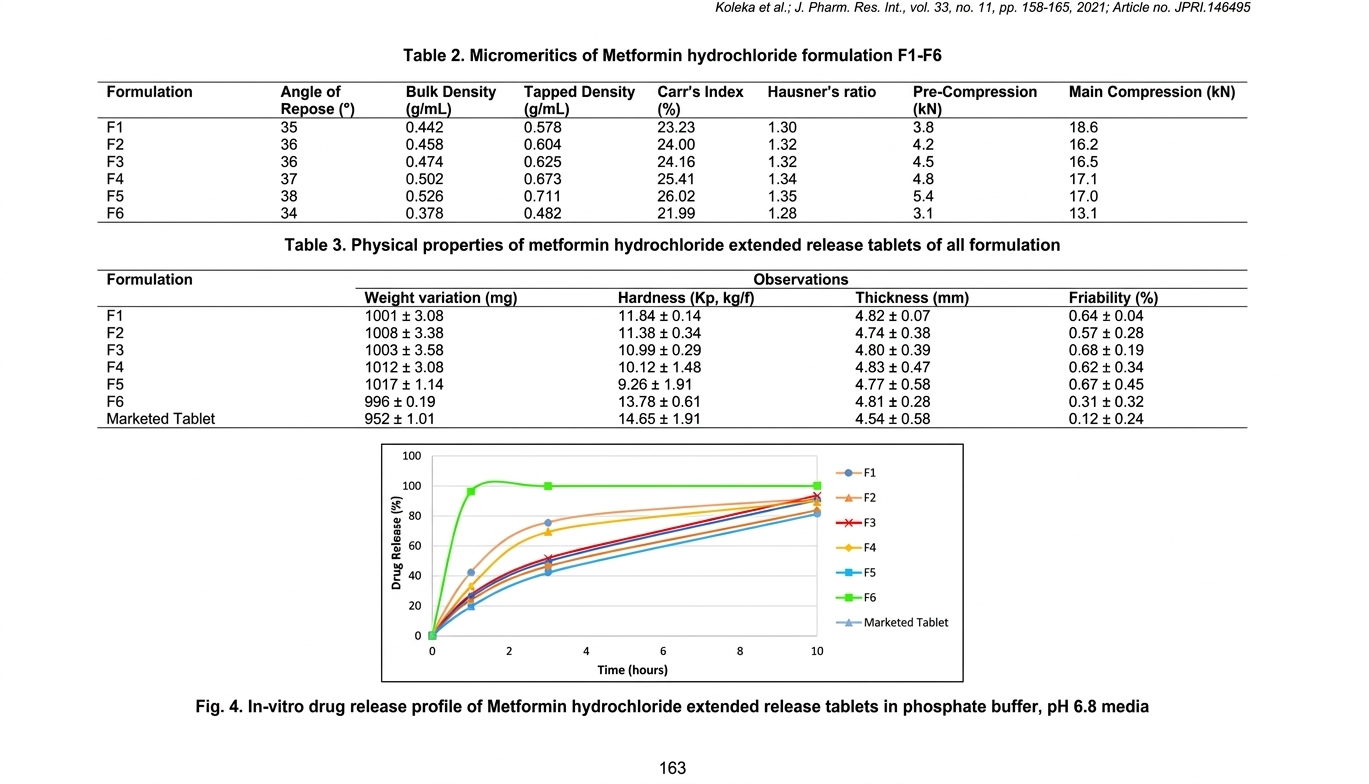
chloride tablets using ULTRAMODTM To evaluate the functionality of polymer matrix in controlling release of metformin HCl, initially five different formulations were prepared (entitled F1,F2, F3, F4, F5 and F6), given in Table 1.Accurately weighed quantities of metformin hydrochloride (previously sifted through a 30#ASTM), polymer premix and other tablet excipients (previously sifted through a 30# ASTM)
were transferred into a powder blender of appropriate capacity (Make: Reva Pharma Machinery, India, Model: TRMIX-20). These materials were mixed for 10 minutes at 25 revolutions per minutes. To this premix, an accurately weighed required quantity of lubricant (previously sifted through a 60-mesh stainless steel sieve) was added and mixed for not more than 3 minutes at 25 revolutions per minutes to obtain a final blend. The final blend was characterized by angle of repose, untapped bulk density, tapped bulk density, Hausner’s ratio, and compressibility index parameters. Then this
blend was compressed into tablets by using a12-station tablet compression machine (Make:Eliza Press, India, Model: EP-200) fitted with 15 mm diameter standard concave shaped “D”tooling sets. Different compositions polymer
premix were formulated as shown in Table 1.Relative humidity and temperature were maintained below 45% and 25°C respectively.
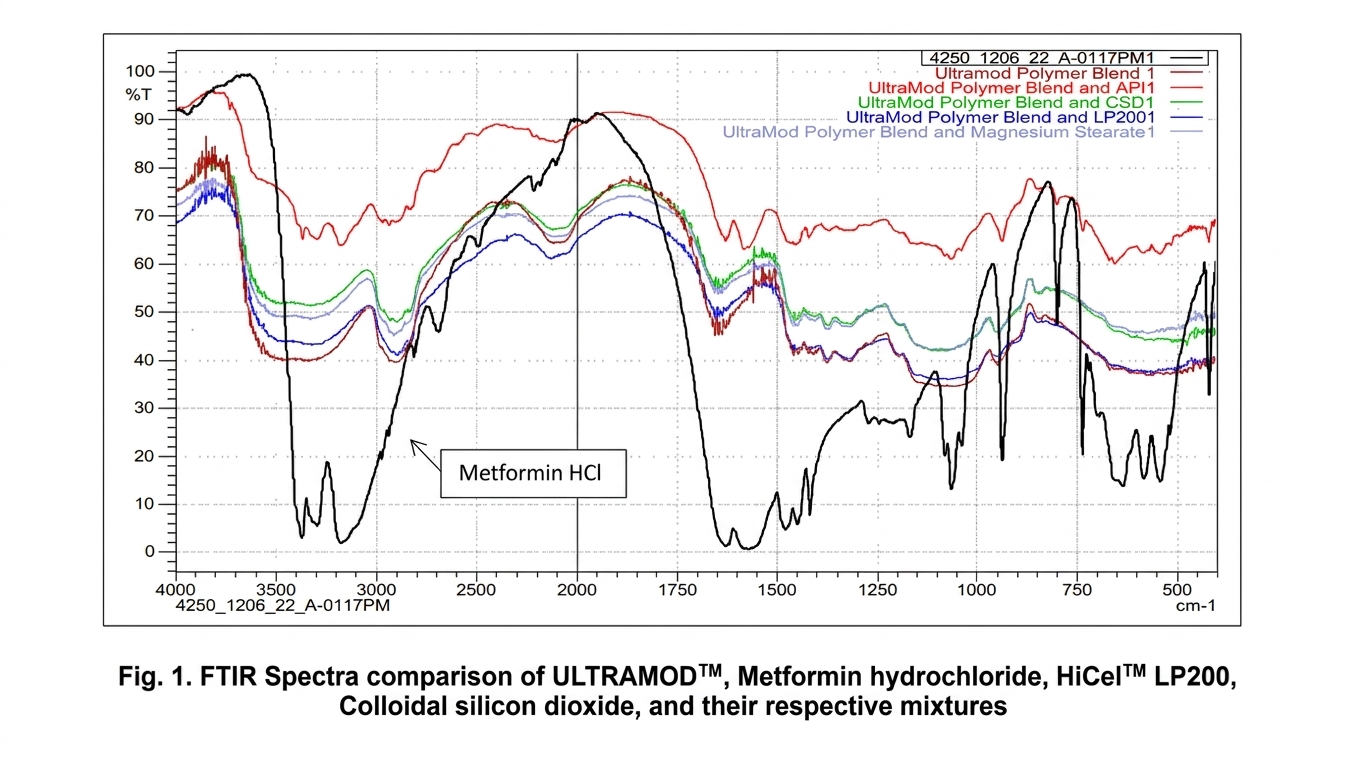
2.3 Excipients Compatibility Studies Molecular interactions as an indication of
compatibility between ingredients were studied using Fourier transform infrared spectroscopy (FTIR) (Make: Shimadzu Japan, Model: IR Spirit-
S), and the spectrum was recorded in the wavelength region from 4000 to 400 cm−1 by using the diffuse reflectance system (DRS) method. The procedure consisted of mixing a sample with potassium bromide and placing it
into a sample disc (Sathoskar et al., 2009). 2.4 Evaluation of Physical Properties of a Powder Blend Containing ULTRAMODTM The powder blend was evaluated for bulk density (untapped and tapped), flow properties

(Hausner’s ratio, Carr’s index), and angle of repose as per USP-NF 2024 General Chapters <616> (Method I) and <1174> (Method 1). For untapped bulk density, a 25 mL graduated cylinder was filled with powder, and the volume
was recorded without compaction. Tapped bulk density was determined using a tapped density tester (500 taps) per USP <616>. Hausner’s ratio
and Carr’s index were calculated from these densities to assess flowability. The angle of repose was measured using a fixed funnel method. All tests were performed in triplicate (n=3) using powder blends from three independent batches to ensure reproducibility (Armin and Gerhardt, 2009). Hausner’s Ratio = Tapped Density Untapped Density Compressibility Index (%) = Tapped Density−Untapped Density Tapped Density × 100 2.5 Evaluation of Physical Properties of Metformin HCl Extended Release
Tablet 2.5.1 Weight variation Tablet weight variation was evaluated as per
USP general chapter <905> (2024). Twenty tablets were randomly selected and individually weighed using an analytical balance. The average weight was calculated, and the percentage deviation of each tablet from the average weight was determined. Acceptance criteria for tablets weighing more than 324 mg,

Table 1. Various formulations of metformin hydrochloride extended release tablets
Ingredients Quantity/tablet (mg)

F1 F2 F3 F4 F5 F6
Metformin hydrochloride 500.0 500.0 500.0 500.0 500.0 500.0
ULTRAMODTM 50.0 100.0 150.0 200.0 250.0 –
HiCelTM LP200 430.0 380.0 330.0 280.0 230.0 480.0
Colloidal silicon dioxide 10.0 10.0 10.0 10.0 10.0 10.0
Magnesium stearate 10.0 10.0 10.0 10.0 10.0 10.0
Average Tablet Weight (mg) 1000.0 1000.0 1000.0 1000.0 1000.0 1000.0
2.5.5 In-vitro drug release
The dissolution profile of Metformin hydrochloride extended release tablet was performed using
dissolution test apparatus (Make: Labindia India, Model: DS8000) by using the USP 44 compendial
method, apparatus II (paddle), speed 100 revolutions per minutes for 10 hours in 1000 mL of
phosphate buffer pH 6.8 at 37 ± 0.5°C medium temperature. Six tablets were placed in each
dissolution vessel. Sample aliquots of 5 mL were withdrawn from each dissolution vessel at 1 hour, 3
hours, and 10 hours. After withdrawal, samples were filtered through Whatman filter paper (No. 42). 1
mL of filtrate from the beaker was taken and transferred into 10 mL of volumetric flask and diluted up
to 10 mL with dissolution medium. The same procedure was repeated for all the remaining 5 tablets.

Standard and sample absorbances were recorded using a UV visible spectrophotometer (Make:
Shimadzu Japan, Model: UV-1900) at λ = 232 nm wavelength. The metformin hydrochloride released
from the tablet formulations was calculated using the below-mentioned formula (USP-NF, 2024).
Amount of drug released (mg) = Concentration of released drug × Dilution factor × Volume of dissolution medium 1000 Drug released (%) = Amount of drug released (mg) label claim (mg) × 100


2.5.6 Calibration curve of metformin hydrochloride Phosphate buffer pH 6.8 filtered through whatman filter paper used as a diluent for preparing the standard solution of the drug. About 10 mg of metformin hydrochloride was
accurately weighed and transferred into a 100 mL volumetric flask, the solution was sonicated and the resulting solution was diluted with the diluent to obtain a primary stock solution to obtain 100 μg/mL metformin hydrochloride. From
this solution, suitable standard solutions of different concentrations were prepared. Linearity of the absorbance was determined by measuring standard dilution of metformin hydrochloride in the range of 10-40 μg/mL. The
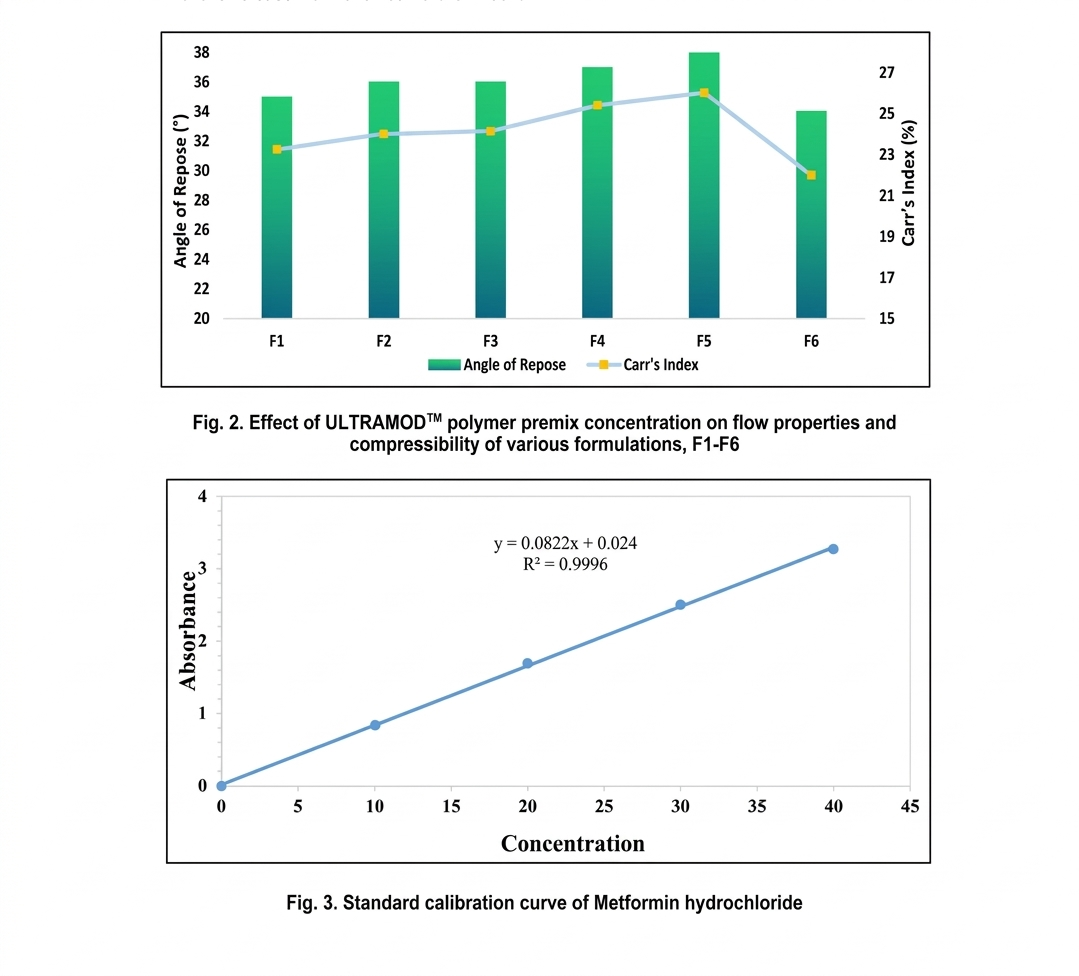
absorbance of metformin hydrochloride was monitored at 232 nm and the corresponding absorbances were obtained. From these absorbances, a graph of concentration andabsorbance was plotted. The regression equation (Fig. 3) obtained was used to estimate the amount of drugs present in tablet dosage
formulations. 2.6 Stability Studies The ULTRAMODTM was packed in double poly- lined paper bag and subjected to accelerated stability conditions at 40±2°C / 75±5% RH for 6 months as recommended by ICH Q1A (R2) guidelines (ICH, 2003) at regular intervals. The sample were examined for any physical changes (colour, texture), aggregation and its micromeritics.
3. RESULTS AND DISCUSSION
Formulations were prepared by varying amounts of ULTRAMODTM polymer premix in the tablet formulation to see the effect of their concentrations on drug release rate and powder micromeritics. These powder blends study were physically evaluated for following parameters.

3.1 Characterization of Powder Blends Containing ULTRAMODTM and
Metformin Hydrochloride 3.1.1 Compatibility studies FTIR spectra of metformin hydrochloride and the powder blend containing ULTRAMODTM were found to be super imposed. The spectra of the formulations showed no additional peaks in the functional group and fingerprint regions. This
indicated that there was no alteration in the molecular structure and functional groups in the blend. According to this investigation, metformin hydrochloride remained chemically unaltered when present in polymer matrix tablets.
As the concentration of the polymer premix increased, a corresponding rise in both bulk and tapped densities was observed. This trend suggested that the powder blend became more compactable with higher polymer content. Specifically, the tapped density increased from 0.576 g/mL in formulation F1 to 0.711 g/mL in formulation F5, indicating improved particle packing at elevated concentrations of ULTRAMODTM, as presented in (Table 2). This may be attributed to the enhanced cohesiveness and better filling efficiency provided by the polymer matrix. Interestingly, formulation F1 exhibited superior flow properties compared to F5, as reflected by its lower Carr’s Index. Moreover, F1 showed slightly better compressibility, as evidenced by a lower Hausner’s ratio, further supporting the influence of polymer concentration on powder characteristics.
Formulations with a greater polymer content (such as F4 and F5) showed higher angle of repose and Carr’s index values of all specimens
Fig. 2. This suggested poor flowability, which may make tablet manufacturing more difficult (United States Pharmacopeia, 2024). The
compressibility of the powder blend significantly increased as the polymer content increased. According to this, powder mixes that contained more polymers are more compressible and less free-flowing.
3.1.2 Evaluation of physical parameters of metformin hydrochloride extended
release tablet In the present work, matrix type metformin HCl tablets were prepared by direct compression technique.

3.1.2.1 Properties of metformin hydrochloride extended release tablets
Their physical parameters such as weight variation, hardness, thickness and friability as essential indicators of quality and consistency were evaluated (Table 3). Tablet formulations containing F3 showed better appearance,
minimal visual defects and smooth edges, which were evaluated based on visual observation than the tablets containing F1, F2, F4, F5 and F6 formulations. All the tablets passed the weight variation test, as the percentage weight variation
was within pharmacopoeial limits of ±5% of the weight as mentioned in (Table 3). Tablet hardness is an essential parameter, as it impacts on the drug’s release profile and their mechanical stability. Formulation F1 exhibited the highest
hardness 11.84 ± 0.14 [Kp(kgf)], while formulation F5 showed the least hardness 9.26 ± 1.91 [Kp(kgf)] as mentioned in (Table 3). The
decrease in hardness from F1 to F5 suggests that increased ULTRAMODTM polymer matrix concentration might result lower the tablet hardness at applied compression forces. This trend could impact the release characteristics of
the drug, as softer tablets tend to disintegrate
more readily. The thickness of the tablets ranged from 4.74 mm ± 0.34 to 4.83 mm ± 0.47 (Table 3). This consistency indicated uniform compression
ability of ULTRAMODTM across all formulations, despite differences in polymer concentration. The friability results within the acceptable limit of less
than 1%. which indicated that the tablets containing ULTRAMODTMobtained by direct compression had reasonable strength. ULTRAMODTM though significantly influenced the modified-release behavior, the role of HiCelTM, a
microcrystalline cellulose-based filler, should not be overlooked. Varying concentrations of HiCelTM altered tablet porosity, hardness, and
disintegration time, thereby affecting overall release performance. Hence, the observed tablet behavior is likely due to the combined effects of both ULTRAMODTM and HiCelTM. 3.1.3 In-vitro dissolution study of metformin
hydrochloride extended release tablet The drug release profile is the most critical factor in evaluating the extended release formulation, prepared with different concentrations of ULTRAMODTM polymer premix (Table 4).
As mentioned in Fig. 4, the average percentage of drug release was assessed at intervals of 1 hour, 3 hours and 10 hours. The results of the drug release profile of Metformin hydrochloride extended release tablets in various
formulations (F1–F6) are demonstrated in Fig. 4. F6 which was formulated without the ULTRAMODTM polymer premix, exhibited immediate release with over 96.18% ± 1.06 of the drug released within 1 hour as mentioned in Fig. 4. Formulation F1 showed drug release slightly above compendial specifications with values of 42.15% ± 0.98. F1 showed drug release percentages slightly above the specified range with values of 75.84% ± 1.46. This highlights the
critical role of ULTRAMODTM in modifying metformin release from tablet formulations.

Table 4. Metformin hydrochloride extendedrelease tablet drug release specification asper USP monograph (USP-NF, 2024)Time intervals Amount drug released1 hour Between 20% to 40%3 hours Between 45% to 65%10 hours Not less than 85%Formulation F2 showed drug release after 1 hourwithin the specified limit but, after 3 hours, drugrelease was slightly above the specified rangewith values of 68.93% ± 0.82 as mentioned in(Fig. 4). Formulation F3 was superior in balancing drug release and tablet physical properties. It offered extended release over 10 hours and closely matched the performance as
per compendial drug release specifications as well as the marketed tablet. Although the formulation demonstrated a release profile similar to the marketed product, it is important to acknowledge that batch-to-batch variability existed in commercial formulations. The optimal amount of ULTRAMODTM polymer premix, about 15% w/w (150 mg/tab), ensured the desired release profile. Whereas tablets containing formulations F4 and F5 showed drug release after 10 hours less than 85%, as mentioned in (Fig. 4). Amongst various formulations of Metformin HCl with ULTRAMODTM the tablets containing 15% ULTRAMODTM showed 26.93% drug release in 1 hour, 51.13% drug release in 3hours and 93.18% drug release in 10 hours as specified by Metformin HCl extended release tablet USP-NF monograph (Karsten and
Katharina, 2004). Such performance was unchanged even after using ULTRAMODTM which was stored at 40°C/75% RH for 6 months in simulated packing materials. Also critical material attributes of this polymer premix, such as density, flow properties, particle size distribution, viscosity, residue on ignition were found to be comparable to those during initial evaluation.

Table 5. Stability study on Micromeritics of ULTRAMODTM stored at 40±2°C/75±5% RH for 6 months Test Parameters Observations Description A white to off white color powder pH (1% solution) 7.01 Loss on drying (%) 5.18% Residue on ignition (%) 6.70% Viscosity (centipoise) 7570 centipoise It was observed that crucial physico-chemical parameters of ULTRAMODTM charged on accelerated stability conditions remained unchanged even after 6 months, as tabulated below. This indicated that ULTRAMODTM polymer premix would continue to contribute to unchanged quality and performance characteristics of formulation during storage also. 4. CONCLUSION Metformin hydrochloride tablet formulation ‘F3’ with an excellent micromeritics (Bulk density >
0.6 g/mL) and improved processability (Hausner’s ratio ~ 1.3 and Carr’s index < 25%) could be produced by direct compression method. Drug release from such matrix tablets evaluated by compendial method showed that such
polymer premix was effective at as low as 15% w/w concentration. Such performance was comparable to that of a well-known marketed formulation, which was proposed to have produced by conventional multi-step manufacturing process. This highlighted superiority of co-processed polymer premix in formula optimisation, simplifying manufacturing and increasing speed to market. Further, such formulation quality attributes and performance were unchanged when the polymer premix stored at accelerated conditions for 6 months was used. This provided a confidence to the formulators that such co-processed polymer premix has robust physico-chemical nature thus ensuring least variations in the product quality. The present study demonstrated advantageous substitute to such conventional polymers by developing a co-processed premix containing time-tested polymers, like hypromellose and
carmellose sodium in accurate quantities. Hence this ensured less tedious formulation development and quick manufacturability of extended release formulations. CONSENT AND ETHICAL APPROVAL
It is not applicable. DISCLAIMER (ARTIFICIAL INTELLIGENCE) Author(s) hereby declare that NO generative AI technologies such as Large Language Models (ChatGPT, COPILOT, etc.) and text-to-image generators have been used during the writing or editing of this manuscript. COMPETING INTERESTS Authors have declared that they have no known competing financial interests or non-financial

interests or personal relationships that couldhave appeared to influence the work reported in this paper.
REFERENCES
Armin, H., & Gerhardt, G. (2009). Moisture effects on solid dosage forms formulation processing and stability. Journal of GXP Compliance, 13, 58–66.
Brahmankar, D. M., & Jaiswal, S. B. (2009). Biopharmaceutics and pharmacokinetics (2nd ed., pp. 399–401). Vallabh Prakashan. Chein, Y. W. (1992). Novel drug delivery systems (2nd ed., pp. 1–42). Marcel Dekker.
Karsten, H., & Katharina, M. P. (2004). Evaluation of a new co-processed
compound based on lactose and maize starch for tablet formulation. AAPS
PharmSciTech, 6, 1–12. Lalla, J. K. (1991). Introduction to controlled
release and oral controlled drug delivery system. Eastern Pharmacist, 45, 25–28. Modi, S. A., Gaikwad, P. D., Bankar, V. H., & Pawar, S. P. (2011). Sustained release drug delivery system: A review. International Journal of Pharmaceutical
Research and Development, 2(12), 147– 160. Pockle, R. D., Masareddy, R. S., Patil, A. S., & Patil, P. D. (2023). A comprehensive review on pharmaceutical excipients. Therapeutic Delivery, 14(7), 443–458. Rajarao, C. H., & Rohini, P. (2020). Formulation design of empagliflozin and metformin
hydrochloride extended release tablets: Optimization of formulation using statistical experimental design. International Journal of Pharmaceutical Sciences and Research, 11(12), 6434–6447. Rowe, R. C., et al. (2023). Handbook of pharmaceutical excipients (9th ed.). Pharmaceutical Press.
Roy, H., Brahma, C. K., Nandi, S., & Parida, K. R. (2013). Formulation and design of sustained release matrix tablets of metformin hydrochloride: Influence of hypromellose and polyacrylate polymers. International Journal of Applied and Basic Medical Research, 3(1), 55–63. Sathoskar, R. S., Bhandarkar, S. D., & Nirmala, N. (2009). Pharmacology and pharmacotherapeutics (Re-revised 21st ed., p. 895). Popular Prakashan. Sousa, A. S., Serra, J., Estevens, C., Costa, R., & Ribeiro, A. J. (2023). A quality by design approach in oral extended release drug delivery systems: Where we are and where we are going? Journal of Pharmaceutical Investigation, 53(2), 269–
306. Takasaki, H., et al. (2015). The importance of binder moisture content in metformin HCl granulation and tablet compactibility. International Journal of Pharmaceutical Sciences and Research, 6(1), 123–130. United States Pharmacopeia (USP). (2024). Metformin HCl extended release tablet.
United States Pharmacopeial Convention. United States Pharmacopeia–National Formulary (USP–NF). (2024). General chapters
<616> bulk density and <1174> powder flow. United States Pharmacopeial
Convention. United States Pharmacopeia–National Formulary (USP–NF). (2024). General chapter <1217> tablet breaking force. United States Pharmacopeial Convention. United States Pharmacopeia–National Formulary
(USP–NF). (2024). General chapter <1216> tablet friability. United States
Pharmacopeial Convention. United States Pharmacopeia–National Formulary
(USP–NF). (2024). Uniformity of dosage units <905>. United States Pharmacopeial Convention. Van der Merwe, J., Steenekamp, J., Steyn, D., &
Hamman, J. (2020). The role of functional excipients in solid oral dosage forms to overcome poor drug dissolution and bioavailability. Pharmaceutics, 12(5), 393.

Author: Sigachi

Leave a Reply

Privacy Policy | Covid Update
Copyright © 2021 Sigachi Industries. All rights reserved.
This site is protected by reCAPTCHA and the Google Privacy Policy and Terms of Service apply.